Your diabetes team may decide to continue your present insulin-to-carbohydrate ratio when you start pump therapy. If this is the case and you know your ratio, please move on to the next topic.
Otherwise, follow the steps below to calculate your pump insulin to carbohydrate (CHO) ratio (this calculation is also available in a printable worksheet here):
You may already be using an insulin-to-carbohydrate (CHO) ratio to calculate how much insulin to take at mealtimes. This is based on the number of insulin units per 10g of carbohydrate or CP (carbohydrate portion).
When using a pump, it is more common to have a ratio where 1 unit of insulin is given for a calculated amount of carbohydrate. This allows a more accurate bolus dose calculation.
Calculate your total daily pump dose as described in the previous ‘Initial insulin doses’ topic.
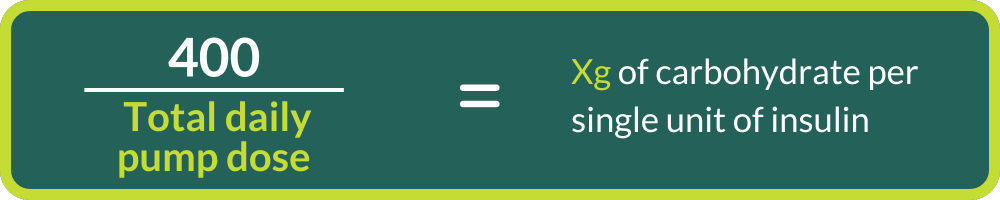
Divide 400 by your total daily pump dose to work out how many grams of carbohydrate 1 unit of insulin will cover.
ALWAYS CHECK THESE CALCULATIONS WITH A HEALTHCARE PROFESSIONAL BEFORE PROGRAMMING YOUR PUMP
Example
Total daily pump dose = 30 units

Rounded down, this means you will need approx 1 unit of insulin for every 13 g of carbohydrates.
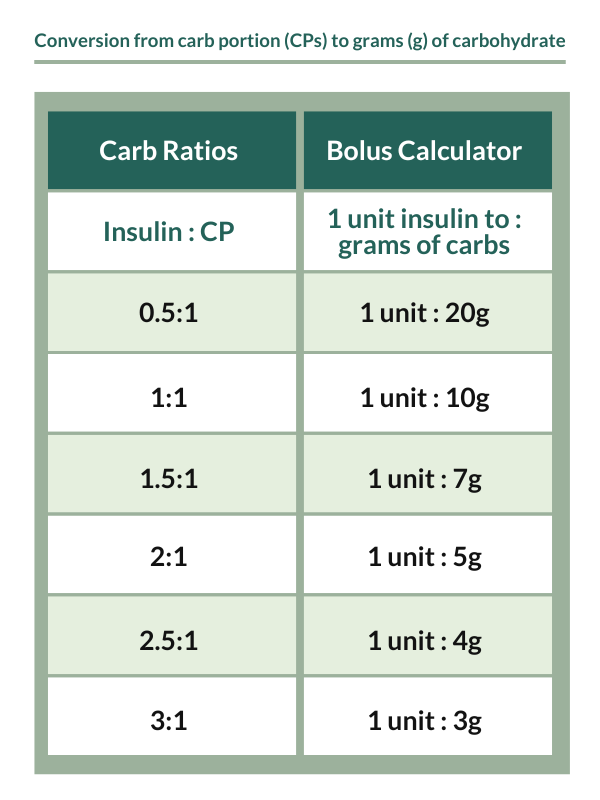
Insulin to Carbohydrate Ratio Ready Reckoner
If you’re a DAFNE graduate and are starting with an insulin pump, then you might be using carbohydrate portions (CPs) instead of grams. To use your insulin pump you will need to switch to counting grams. The insulin to carbohydrate ratio ready reckoner helps make this conversion clear.
Boluses
You should give meal-time boluses ideally 5–15 minutes before meals. Your pump may have different speeds/ways of delivering the mealtime bolus.
You can use different bolus modes depending on the type of food being eaten. Your insulin pump team can discuss the options with you.
“400 divided by 30 equals 13.3 grams of carbohydrate per single unit of insulin” looks a bit odd – is it supposed to be a graphic?