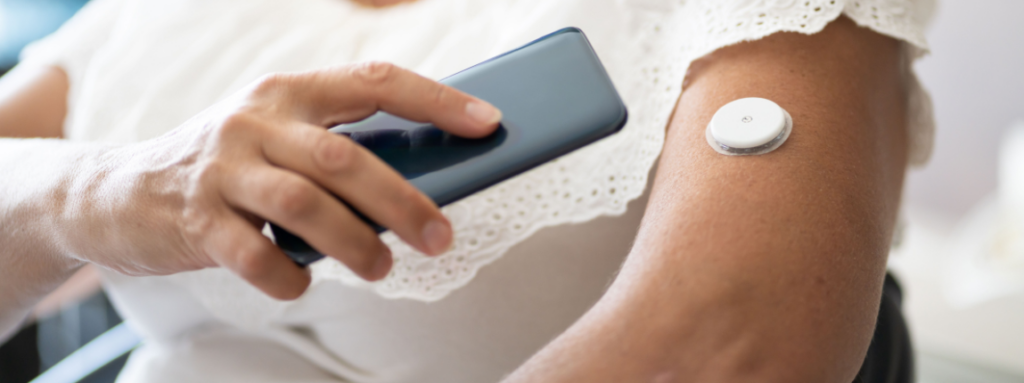
Continuous glucose monitoring (CGM) enables you to check your glucose levels without regularly pricking your finger. Instead, a small sensor sits on your upper arm, automatically measuring and continuously storing glucose readings day and night. The readings can be viewed on a mobile phone or a handheld monitor.
The difference between glucose and sensor glucose
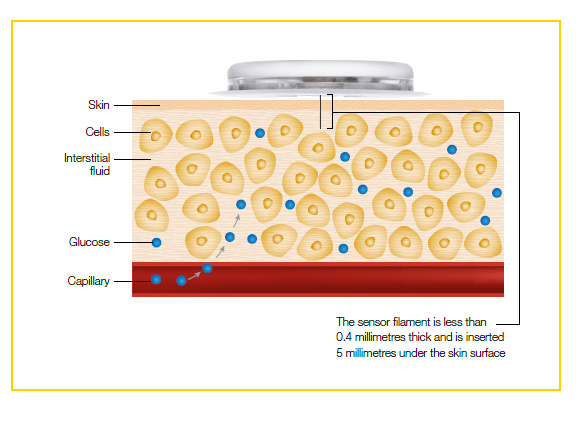
Unlike current glucose meters, the CGM sensor measures the glucose in the body’s interstitial fluid (ISF). Interstitial fluid is the body fluid between blood vessels and cells beneath your skin. The diagram below shows a sensor on the skin, a layer beneath with interstitial fluid and cells, and glucose molecules entering from the small blood vessel called a capillary. The sensor filament is very small (less than 0.4 mm thick). It is inserted just under the skin surface.
Finger-prick glucose readings and sensor glucose readings won’t always match, and in fact, are likely to be different because sensor glucose readings come from the interstitial fluid, not from your blood.
Glucose in the ISF lags behind that in the blood. A CGM glucose reading generally indicates what the glucose was 5-15 minutes ago. Most of the time, this delay doesn’t matter as glucose levels are relatively stable. However, it is important to be aware of this delay when glucose levels are changing rapidly, such as after a meal or during exercise. In these situations, the delay between glucose and ISF glucose can also be longer.
Difficult to know how pedantic to be?
How different can readings be?
WHat about blood glucose level always gold standard so to do a check if not sure?
?Mention hydration affecting readings?
You mention wearing CGMS on upper arm? WHat about other sites with Dexcom?
Change
” a small sensor sits on your upper arm”
to
” a small sensor sits on your skin”
Change
” Refer to the diagram below: It shows the sensor on the skin, a layer beneath with interstitial fluid and cells, and glucose molecules entering from the capillary. The sensor filament is less than 0.4 mm thick. It is inserted 5 mm under the skin surface.”
to
“The diagram below shows a sensor on the skin, a layer beneath with the interstitial fluid and cells, as well as the glucose molecules entering from the small blood vessel called the capillary. The sensor filament is very small (less than 0.4 mm thick). It is inserted just under the skin surface.”